

Our emerging technologies includes technology under development by our R&D department –this is where technologies become solutions. We develop technology within our core areas:
Emerging Environmental Sensors
Environmental sensors have been our primary core technology since our operations began in 2004. InnoSense CEO Dr. Kisholoy Goswami commercialized the world’s first fiber-optic chemical sensor for hydrocarbons in the 1980s. Our sensor technologies address diverse markets and industries. From monitoring major atmospheric constituents in spacecrafts to sub-surface CO2 plumes – up in space or below the earth’s surface – our versatile sensors offer cost-effective performances.
Many of our sensors have been designed to operate in harsh environments such as rocket exhausts and space. All our sensors feature lightweight and robust designs. Learn more about our environmental sensors, their development and how we can work together to find a solution to your needs.
Nanowire-based Environmental Sensors
Our novel nanowire-based electrochemical sensors can monitor chemical (and biological) analytes. The micron‐sized electrode junctions, modified with nanowires, are easily packaged into a sensor array for multi-analyte detection. This array can detect atmospheric gases, toxic chemicals, biochemicals, and hypergolic fuels.
Using this technology, we are developing HypergoLeak, a hypergolic propellant leak detector currently undergoing commercialization and PNESA, Polymer Nanowire‐Based Electronic Sensor Array for Carbon Dioxide Monitoring.
MOSA: Multi-Analyte Optical Sensor Array for hydrogen, oxygen, humidity and carbon dioxide monitoring
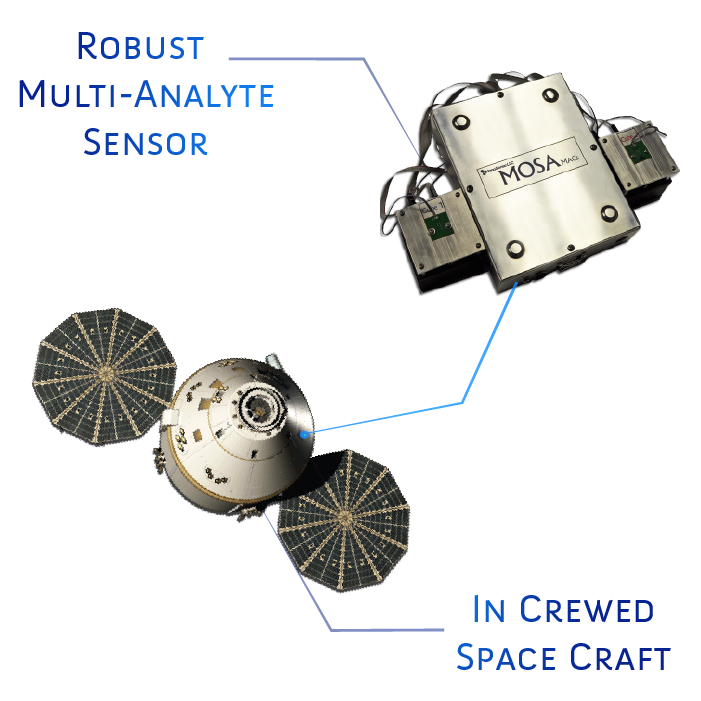
MOSA is a lightweight, multi- analyte optical sensor that can detect oxygen, carbon dioxide and humidity over a wide dynamic range (0-100% for 02 and CO2 and 20-80% for relative humidity). Originally designed for the space program, MOSA meets NASA’s requirements for an integrated compact and automated sensor that can measure atmospheric constituents in spacecrafts throughout long duration missions. MOSA can measure industrial and hazardous gaseous analytes remotely with higher sensitivity than other sensors. This multi-analyte sensor can be used for fuel tank, oil and gas production and engine efficiency monitoring.
DOSHO: Discriminating Optical Sensor for Hydrogen in Oxygen
DOSHO can detect trace amounts of hydrogen (10ppm) in an oxygen background. DOSHO will selectively detect hydrogen even with interference from oxygen, moisture and trace levels of ammonia, hydrofluoric acid, carbon monoxide or carbon dioxide. The optoelectronics are rugged and robust with drift-free sensor performance. Originally under development for leak detection in the International Space Station and future spacecraft, other applications for DOSHO include analyzing electrolysis and fuel cell process streams.
FogGo coated surfaces offer enhanced abrasion resistance when tested using Bayer and Taber Abrasion protocols.
Lorem ipsum dolor sit amet, consect adipiscing elit, sed diam nonummy.
Emerging Environmental Sensors
Environmental sensors have been our primary core technology since our operations began in 2004. InnoSense CEO Dr. Kisholoy Goswami commercialized the world’s first fiber-optic chemical sensor for hydrocarbons in the 1980s. Our sensor technologies address diverse markets and industries. From monitoring major atmospheric constituents in spacecrafts to sub-surface CO2 plumes – up in space or below the earth’s surface – our versatile sensors offer cost-effective performances.
Many of our sensors have been designed to operate in harsh environments such as rocket exhausts and space. All our sensors feature lightweight and robust designs. Learn more about our environmental sensors, their development and how we can work together to find a solution to your needs.
Nanowire-based Environmental Sensors
Our novel nanowire-based electrochemical sensors can monitor chemical (and biological) analytes. The micron‐sized electrode junctions, modified with nanowires, are easily packaged into a sensor array for multi-analyte detection. This array can detect atmospheric gases, toxic chemicals, biochemicals, and hypergolic fuels.
Using this technology, we are developing HypergoLeak, a hypergolic propellant leak detector currently undergoing commercialization and PNESA, Polymer Nanowire‐Based Electronic Sensor Array for Carbon Dioxide Monitoring.
MOSA: Multi-Analyte Optical Sensor Array for hydrogen, oxygen, humidity and carbon dioxide monitoring
MOSA is a lightweight, multi- analyte optical sensor that can detect oxygen, carbon dioxide and humidity over a wide dynamic range (0-100% for 02 and CO2 and 20-80% for relative humidity). Originally designed for the space program, MOSA meets NASA’s requirements for an integrated compact and automated sensor that can measure atmospheric constituents in spacecrafts throughout long duration missions. MOSA can measure industrial and hazardous gaseous analytes remotely with higher sensitivity than other sensors. This multi-analyte sensor can be used for fuel tank, oil and gas production and engine efficiency monitoring.
DOSHO: Discriminating Optical Sensor for Hydrogen in Oxygen
DOSHO can detect trace amounts of hydrogen (10ppm) in an oxygen background. DOSHO will selectively detect hydrogen even with interference from oxygen, moisture and trace levels of ammonia, hydrofluoric acid, carbon monoxide or carbon dioxide. The optoelectronics are rugged and robust with drift-free sensor performance. Originally under development for leak detection in the International Space Station and future spacecraft, other applications for DOSHO include analyzing electrolysis and fuel cell process streams.